
PRESBYOND Laser Blended Vision: Surgery & Treatment
Presbyond Laser Blended Vision is an advanced, customised surgical procedure designed to correct age-related reading vision loss (presbyopia), often combined with pre-existing refractive errors such as nearsightedness (myopia), farsightedness (hyperopia), and astigmatism. Building upon proven LASIK technology, Presbyond gently reshapes the cornea of each eye to expand your depth of field, allowing for a seamless transition between near, intermediate, and distance vision without total reliance on multifocal, bifocal or reading glasses.
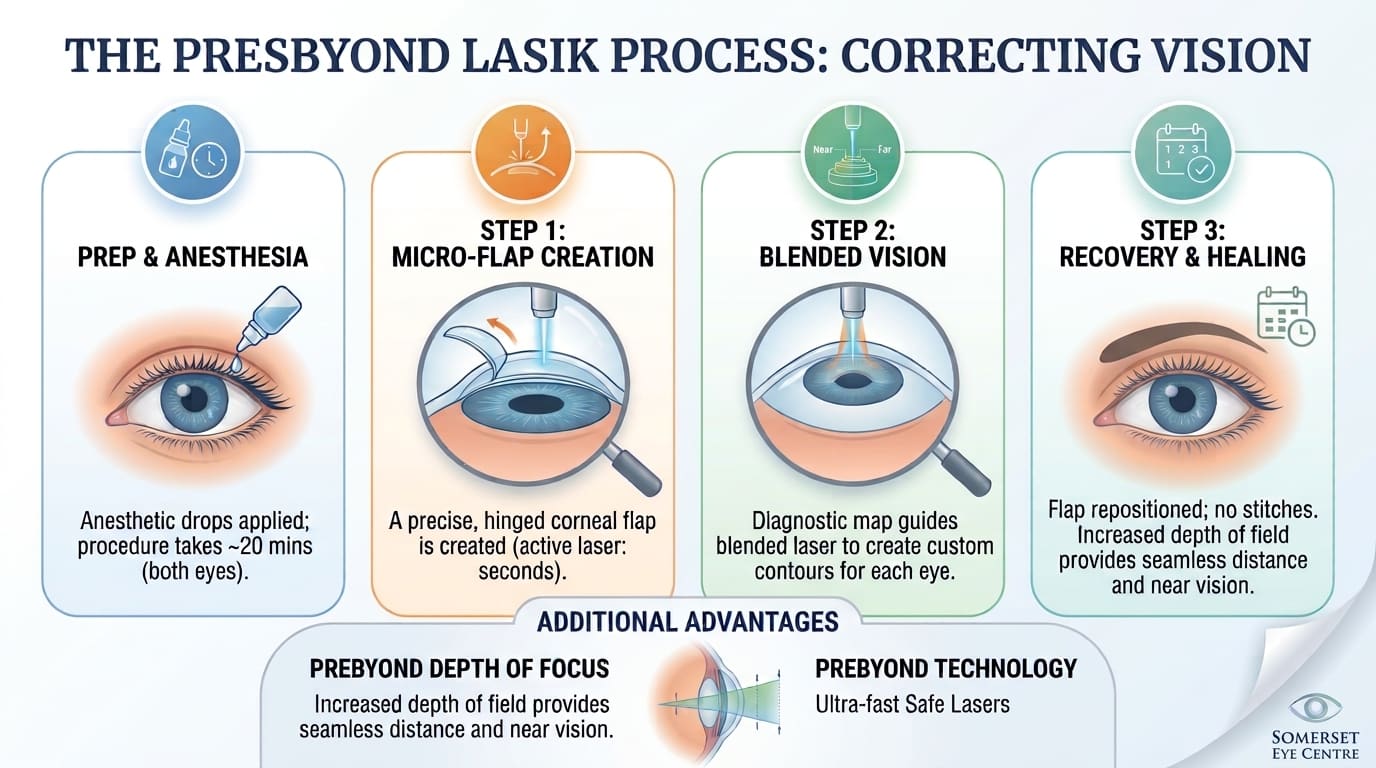
How Presbyond Works: The Surgical Process
Because Presbyond is built on the LASIK platform, it utilises a sophisticated two-step laser approach paired with wavefront-optimized micro-monovision.
-
Step 1: Micro-Flap Creation
An ultra-thin, protective hinged flap is created on the surface of the cornea using a high-precision femtosecond laser. This flap is gently folded back to access the underlying tissue.
-
Step 2: Micro-Monovision & Depth-of-Field Tuning
An excimer laser applies tailored wavefront ablation profiles to each eye. One eye is optimised primarily for distance vision (with a slightly extended depth of field for intermediate distances), while the other eye is optimised primarily for near vision (with an extended depth of field for intermediate distances). The protective flap is repositioned to heal naturally without stitches.
-
Step 3: Neural Fusion (The Blended Zone)
Unlike traditional monovision—which creates a sharp compromise between the two eyes—Presbyond creates a tailored "Blended Zone" where the visual fields overlap. The brain naturally fuses these images together, providing clear sight across near, intermediate, and distance ranges.
What Presbyond Can Correct
As we reach our 40s and beyond, the natural lens inside the eye gradually loses flexibility, making close-up tasks increasingly challenging. Presbyond addresses this aging process alongside existing visual conditions:
-
Presbyopia (Age-Related Near Vision Loss): Restores the ability to comfortably read fine print, view smartphones, and work on screens without constantly reaching for reading glasses.
- Nearsightedness (Myopia): Corrects distance focus while maintaining comfortable close-range vision.
- Farsightedness (Hyperopia): Corrects distance and intermediate clarity while restoring near-focus performance.
- Astigmatism: Corrects irregular corneal curvature so images remain sharp and distortion-free across all distances.
Evaluating Candidate Suitability
While Presbyond is an excellent option for patients experiencing presbyopia, individual candidacy is determined by performing a Laser Suitability Screening.
General Eligibility Criteria
- Age: Typically designed for candidates aged 40 and older who are noticing age-related changes in near vision.
- Prescription & Health Stability: Stable visual prescription with overall healthy eye structures free from advanced cataracts, severe dry eye syndrome, or corneal dystrophies.
- Binocular Adaptation: Candidates undergo dynamic binocular testing during screening to verify that their eyes and visual cortex comfortably adapt to laser blended vision.
The Laser Suitability Screening
Every patient undergoes a thorough Laser Suitability Screening prior to treatment. Using high-resolution corneal topography and optical tomography, we assess corneal thickness, mapping geometry, and tear-film stability to confirm whether Presbyond or an alternative solution (such as SMILE or lens replacement) offers the safest, most effective pathway for your eyes.
Recovery and Post-Operative Expectations
Presbyond shares the quick, comfortable recovery profile characteristic of modern flap-based laser procedures.
- Immediate Post-Op: Mild watering, light sensitivity, or a sensation similar to an eyelash in the eye is normal for the first few hours following treatment.
- Visual Adaptation Period: Most patients notice an immediate improvement in vision within 24 to 48 hours. Full visual integration and adaptation across the Blended Zone comfortably mature over a few weeks to a few months.
- Follow-Up Care: Structured post-operative assessments track corneal healing and confirm smooth binocular fusion.
- Resuming Activities: You can generally return to non-strenuous work, computer use, and light daily routines within 48 hours, keeping to standard precautions regarding water exposure and eye rubbing.
FAQ
No. Traditional monovision has a sharp transition, often causing a "blur zone" between near and far. PRESBYOND creates a "blend zone," allowing a smooth overlap of vision.
No, the procedure is painless, as numbing eye drops are applied beforehand. Some patients might feel mild pressure during the procedure.
While PRESBYOND is long-lasting, it does not stop the natural ageing process of the eye. However, most patients maintain sufficient reading vision for the rest of their lives. If needed, a follow-up ("enhancement") procedure can be done in the future.
While initial visual improvement is immediate, it can take anywhere from a few weeks up to 4–6 months for the brain to fully neuro-adapt to the new "blended" vision.
Risks are similar to standard LASIK, including temporary dry eyes, light sensitivity, or glare/halos at night.
Yes. Even though the goal is to be spectacle-free, some patients might still need light reading glasses for extremely fine print or very low-light conditions.
PRESBYOND is less invasive because it reshapes the surface of the eye (cornea) and does not remove the natural lens. It also avoids the risk of retinal detachments associated with internal lens replacement surgery.
 SERVICES
LASIK (Laser-Assisted In Situ Keratomileusis)SMILE (Small Incision Lenticule Extraction) PRESBYONDPhakic Intraocular Lenses (ICLs) Cataracts and Cataract Surgery Multifocal Intraocular lens Implant Surgery Glaucoma and Glaucoma Surgery Macular Degeneration and Treatment Pterygiums and Surgery Keratoconus and Corneal Crosslinking
